
Google Ads Consultant
Turn Google search demand into a more predictable acquisition channel.
Google Ads should do more than generate clicks. I help businesses build, audit, and optimize paid-search systems that connect search intent, campaign architecture, conversion tracking, landing pages, lead quality, and commercial outcomes.
Whether you need a Google Ads audit, a new campaign structure, ongoing PPC management, better conversion measurement or a senior consultant to work alongside your internal team, the objective is the same: make paid search easier to understand, improve what is limiting performance, and scale what works.

Senior digital marketing consultant • Google Ads • SEO • Growth
Built around business outcomes
Leads • Pipeline • Customers • Revenue
Works across the funnel
Search demand → Click → Conversion → Customer
Senior-level consulting
Strategy, audit, implementation & optimization
The problem
Getting traffic is easy. Getting the right traffic is the hard part.
Google Ads accounts can become complicated quickly. Campaigns accumulate, search terms drift, tracking gets messy, budgets move toward the wrong areas, and a business starts optimizing for metrics that do not necessarily represent commercial value.
You may be dealing with:
- Spend increasing without proportional growth in qualified conversions.
- High cost per lead or customer.
- Leads that look good in Google Ads but perform poorly in sales.
- Irrelevant search terms consuming budget.
- Campaigns that were built around keywords instead of intent.
- Conversion tracking that counts actions without understanding their quality.
- Landing pages that do not match the promise made in the advertisement.
- Difficulty knowing what to fix first.
- Pressure to scale before the economics are proven.
The answer is rarely “just optimize the bids.” Paid search is a connected system, and the highest-impact constraint can exist anywhere from the query to the sales pipeline.
Google Ads consulting framework
A paid-search system should be built in the right order.
I use a practical sequence that starts with diagnosis and commercial intent, then moves through architecture, measurement and optimization before scaling.
01 — Diagnose
Review account structure, search terms, keywords, ads, bidding, budgets, audiences, locations, tracking, landing pages and performance history.
02 — Strategize
Define objectives, customer segments, search intent, markets, offers, conversion goals, budget logic and measurement requirements.
03 — Architect
Structure campaigns, ad groups, keywords, audiences, ads and budgets around meaningful commercial categories.
04 — Implement
Build, restructure, or launch campaigns and connect the supporting landing page and conversion components.
05 — Measure
Separate useful conversions from noise and, where possible, connect paid-search activity to qualified leads, sales opportunities, customers, or revenue.
06 — Optimize & Scale
Prioritize the biggest constraints, validate improvements, then expand the campaign areas that demonstrate viable economics.
What I can help with
From one-off diagnosis to ongoing paid-search leadership.
The engagement can be narrowly defined around a specific problem or broad enough to cover the full Google Ads acquisition system.
Google Ads Audit
Independent account review with prioritized findings, wasted-spend opportunities, structural issues, measurement gaps and an action plan.
Google Ads Strategy
Paid-search strategy aligned to business model, search demand, customer journey, budget and commercial goals.
Campaign Architecture
Campaign, ad-group, keyword and targeting structures designed around intent and control.
Keyword & Search-Term Research
Separate valuable commercial demand from irrelevant, ambiguous or low-value searches.
Campaign Management
Ongoing optimization across search terms, keywords, ads, bidding, budgets, audiences, locations and performance.
Conversion Tracking
Improve the measurement layer across Google Ads, GA4, forms, calls, ecommerce, CRM and qualified-lead signals.
Landing-Page Alignment
Connect query, advertisement, offer, landing page and conversion action so the experience makes sense end to end.
Scaling
Expand winning search themes, products, services, markets or audiences after the economics are validated.
Campaign types
Use the channel that matches the business.
There is no universal “best” campaign type. The right mix depends on search demand, products, audience, data quality, conversion goals and economics.
Search Ads
Capture active demand from people searching for products, services, solutions and commercial information.
Performance Max
Use Google’s broader inventory when the account has appropriate conversion signals, assets and commercial objectives.
Shopping
Connect ecommerce products with search demand through feeds, product segmentation, bidding and conversion-value measurement.
YouTube & Display
Support demand generation, consideration or remarketing where audience, creative and measurement make the channel appropriate.
Measurement
If you cannot trust the conversion data, you cannot trust the optimization.
Tracking is not a technical afterthought. It determines what the account learns, what gets optimized and how confidently you can decide where to invest more budget.
- Form submissions
- Phone calls
- Purchases and transaction value
- Demo and consultation requests
- Free trials and signups
- Qualified leads and sales opportunities
- CRM outcomes and customer revenue
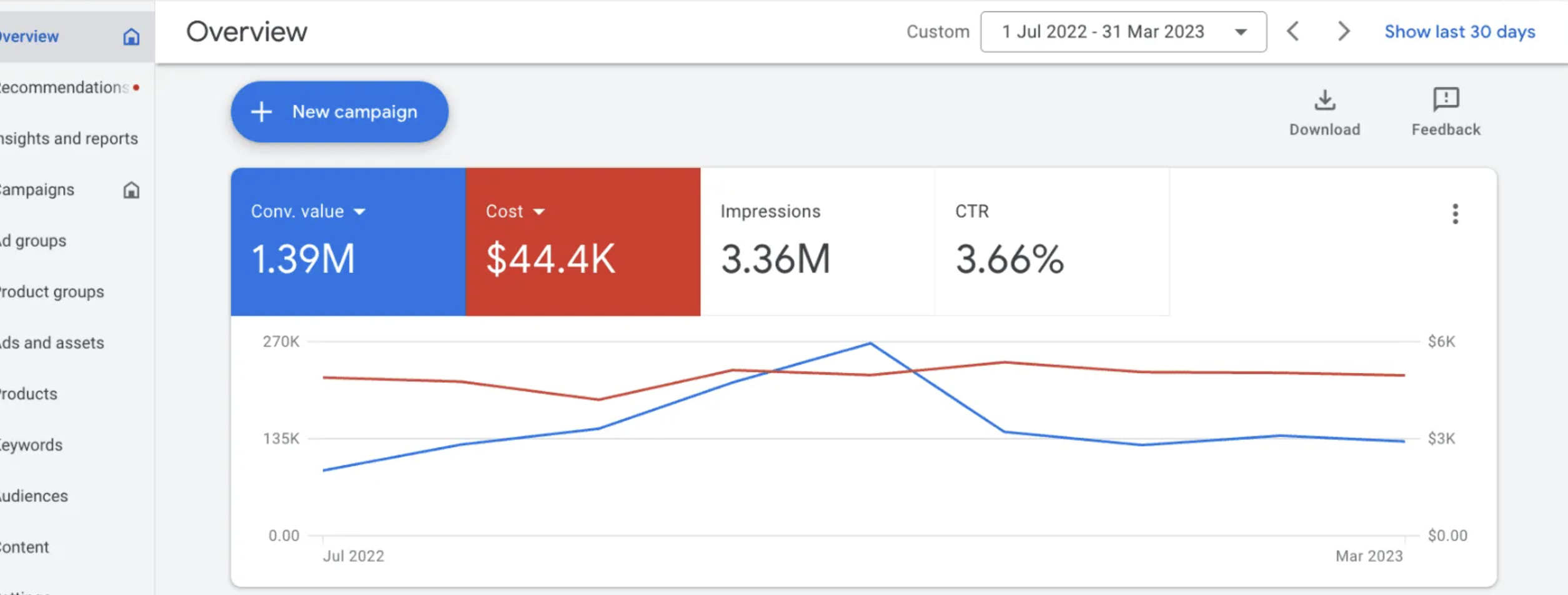
Paid acquisition performance visual
Built for different growth stages
The strategy changes when the business model changes.
A SaaS company, an ecommerce brand and an enterprise B2B business can all use Google Ads, but they should not be measured or structured in exactly the same way.
SaaS
Align search demand with trials, demos, qualified pipeline, customer acquisition cost and recurring revenue.
B2B
Prioritize commercial intent and lead quality, then connect advertising data to qualification and sales outcomes.
Ecommerce
Optimize product visibility, Shopping, Performance Max, conversion value, ROAS, AOV and revenue contribution.
Services
Focus on high-intent searches, location or service segmentation, lead quality, calls, forms and booked opportunities.
Enterprise: account governance, large campaign inventories, geographic markets, budget allocation, CRM integration, reporting and scalable optimization.
Google Ads vs agency
Consultant or agency? Choose based on the problem you need solved.
Neither model is automatically better. The important question is whether you need senior strategy, execution capacity, or both.
| Consultant | Agency |
|---|---|
| Direct senior expertise | Broader delivery team |
| Flexible strategic scope | Managed service structure |
| Strong fit for audits and restructuring | Strong fit for ongoing production |
| Can work with your internal team | Can provide multiple specialists |
| Direct communication with the specialist | Account-management layer may sit between client and specialist |
A consultant can also work alongside an agency when you want an independent strategic review, senior oversight or a second opinion on whether the account is moving in the right direction.
How we work
Clear decisions. Clear priorities. No mystery around what happens next.
I can work as an independent consultant, alongside an internal marketing team, or in coordination with an existing agency or specialist.
01 — Discovery
Understand the business model, offer, customers, markets, sales process, current account and goals.
02 — Audit
Find the constraints, opportunities, wasted spend and measurement gaps.
03 — Priorities
Turn findings into a practical sequence of changes instead of a long list of disconnected recommendations.
04 — Implementation
Build, restructure or guide your team through the highest-impact changes.
05 — Review
Evaluate results against agreed KPIs and identify what the data is actually telling us.
06 — Scale
Increase investment only where performance and business economics justify it.
Why Harpreet Munjal
Paid search sits inside a bigger growth system.
My work spans Google Ads, SEO, AI SEO, conversion optimization, content and digital marketing strategy. That broader view matters because paid search rarely operates in isolation.
- Search data can reveal commercial language and customer intent.
- Landing-page analysis can reveal conversion friction.
- Paid search can validate demand before larger organic investments.
- SEO can build durable visibility around proven search themes.
- CRM and sales feedback can improve the definition of a valuable conversion.
The goal is not to make Google Ads look good inside an advertising dashboard. The goal is to make the acquisition system work better for the business.
What success can mean
Measure the account against the business, not the other way around.
Visibility
Search coverage, impressions and eligible demand.
Traffic quality
Relevant clicks, engaged visitors and commercial intent.
Conversions
Leads, calls, demos, trials, purchases and qualified actions.
Economics
CPA, CAC, ROAS, revenue, pipeline and customer value.
The correct KPI depends on your business model and sales cycle. A low cost per lead is not a win if those leads never become customers.
Google Ads FAQ
Questions businesses ask before hiring a Google Ads consultant.
Practical answers to the questions that matter before you put more budget behind paid search.
What is a Google Ads consultant?
A Google Ads consultant is a paid-search specialist who helps businesses plan, audit, build, measure and improve Google Ads campaigns.
What does a Google Ads consultant do?
The work can include account auditing, keyword and search-term research, campaign architecture, ad strategy, bidding and budget analysis, audience and location targeting, conversion tracking, landing-page alignment, reporting and ongoing optimization.
Why hire a Google Ads consultant instead of managing Google Ads yourself?
A consultant can provide senior expertise and an independent view of the account, particularly when performance has plateaued, spend is increasing, the account has become complex or tracking is unreliable.
How much does Google Ads consulting cost?
Pricing depends on scope and complexity, including advertising spend, campaign count, markets, products or services, conversion tracking, CRM requirements, reporting and whether the work is advisory, implementation-led or ongoing.
What is a Google Ads audit?
A Google Ads audit is a structured review of campaign structure, keywords, search terms, negative keywords, ads, bidding, budgets, audiences, locations, conversion tracking, landing pages and business outcomes.
Can a Google Ads consultant reduce cost per lead?
Consulting can identify inefficient demand, poor targeting, weak account structure, budget allocation issues, bidding constraints, irrelevant searches, landing-page friction and measurement problems.
Can a Google Ads consultant improve lead quality?
Lead quality can be addressed through search-intent analysis, keyword selection, negative keywords, advertisements, landing pages, geographic targeting, conversion definitions and CRM or sales feedback.
Can a Google Ads consultant work with an internal marketing team?
Yes. A consultant can act as a senior specialist while your internal team handles creative, content, development, sales or day-to-day marketing operations.
Can a Google Ads consultant work alongside an agency?
Yes. A consultant can provide independent strategy, audits, restructuring, senior oversight or a second opinion while an agency handles execution.
Can Google Ads work for SaaS, B2B and ecommerce?
Yes. SaaS, B2B and ecommerce businesses can use paid search when campaigns, measurement and optimization are aligned with their specific commercial model.
Ready to fix what is holding paid search back?
Let’s turn Google Ads into a system you can actually scale.
Tell me what you are trying to achieve, what is currently not working and where you believe the biggest constraint is. We can determine whether an audit, strategy engagement, campaign restructuring or ongoing consulting is the right fit.